
How MCP Servers Transform VS Code AI Development 2026
Master MCP servers in VS Code for AI-powered development. Setup local/remote servers, choose the right model, and build agentic workflows. This is the 2026 guide.





Uncovers your entire system architecture - from decades-old foundations to yesterday’s extensions.

Transforms scattered logic into clear, multilingual documentation that stays accurate over time.

Reveals every dependency and consequence before you deploy, reducing risk across the organization.

Manufacturers depend on stable production systems, yet decades of layered RPG, CL, and database logic make it difficult to understand how changes ripple through operations. When teams cannot see how programs, files, and dependencies connect, even routine maintenance carries risk.
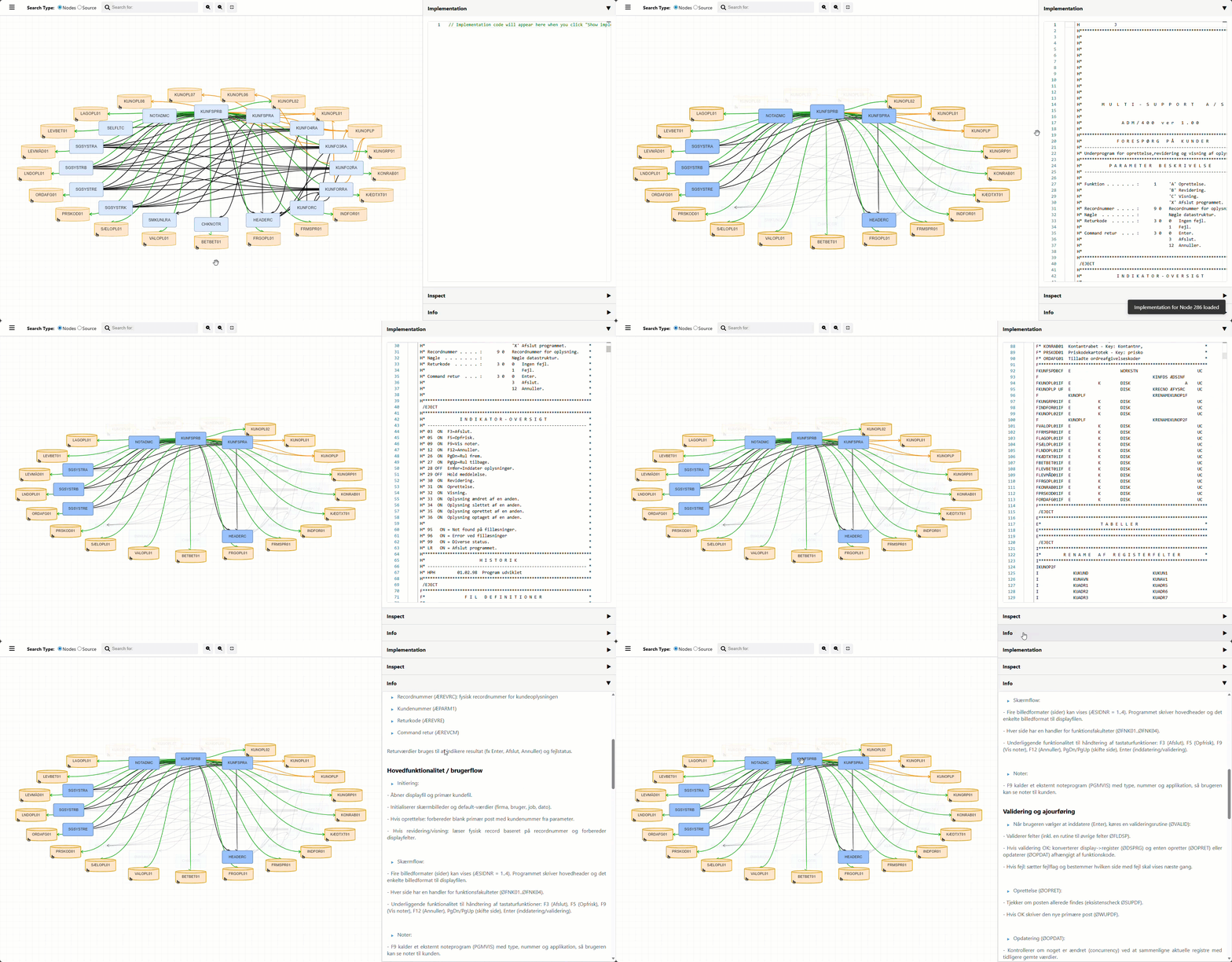
With Blueprint, architects and developers gain a complete visual map of the entire IBM i landscape - including undocumented routines and hidden coupling. Teams can review the structural impact of changes before execution, ensuring upgrades, extensions, or process adjustments are planned with full awareness.
Gain architectural clarity before making operational changes.

Financial institutions rely on IBM i applications that have evolved for decades, often without consistent documentation. During audits, proving how calculations, policies, and data flows are implemented can be slow, manual, and error-prone.
Blueprint automatically generates multilingual, system-accurate documentation directly from live code. Program flows, dependencies, and business rules become traceable and easy to interpret. Audit teams gain immediate visibility into how the system behaves, dramatically reducing preparation time and eliminating uncertainty.
Keep documentation accurate, current, and compliance-ready.

Organizations maintaining large IBM i estates often face uncertainty when modifying shared data fields, business rules, or core logic. Hidden dependencies across hundreds of programs can lead to regressions, production incidents, and extended testing cycles.
Blueprint performs a complete impact analysis across the environment, identifying every object affected by a potential change. Developers gain full transparency into where logic is used, how data flows, and what must be validated before deployment. This ensures controlled releases, fewer defects, and faster delivery.
Make system changes with certainty - even in complex IBM i environments.
Sitemule Blueprint provides the insight required to understand, maintain, and evolve decades-old IBM i (AS/400) applications with confidence. It is a professional application documentation and analysis tool designed to reduce risk while increasing clarity, speed, and control when working with complex and long-lived systems.
Organizations that depend on IBM i applications often face limited or outdated documentation, high onboarding costs for new developers, frequent defects following changes, and ongoing compliance and audit requirements. Sitemule Blueprint is purpose-built to address these challenges by delivering a precise and reliable understanding of how applications actually function.
By replacing manual guesswork with automated analysis, Sitemule Blueprint reveals the true structure of your applications. It makes implicit logic explicit by uncovering hidden dependencies, data flows, and embedded business rules that are otherwise difficult and time-consuming to identify. Complex codebases are transformed into clear, navigable structures that teams can explore with confidence. The result is lower operational risk, faster development cycles, reduced costs, and professional documentation that remains accurate, consistent, and easy to maintain over time.
"By replacing manual guesswork with automated analysis, Sitemule Blueprint reveals the true structure of your applications, making implicit logic explicit by uncovering hidden dependencies, data flows, and embedded business rules."
Sitemule Blueprint analyzes the entire IBM i application landscape, from the earliest legacy components to the most recently deployed extensions. It automatically identifies all relevant objects and their relationships by scanning all available sources, including traditional source physical files (PF-SRC), the Integrated File System (IFS), and modern Git repositories.
This ensures that no part of the application is overlooked, regardless of age, storage location, or development approach, providing a truly comprehensive and authoritative blueprint of the system.
Blueprints are delivered through a web-based interface that requires no local installation and is accessible from any modern browser. Technical information is presented in a context-aware manner, combining diagrams, metadata, and explanatory documentation into a single navigable experience.
Users can quickly understand structure and behavior without needing to search through code or disparate documents, making Blueprint equally valuable for developers, architects, analysts, and auditors.
The application landscape is rendered as a globe, where areas of high interaction intensity appear as large, illuminated “cities.” These clusters highlight heavily used or tightly coupled parts of the system. Color-coded relationships between objects clearly distinguish different types of dependencies and interactions, making overall structure, architectural intent, and potential risk areas immediately visible at both a high-level overview and during detailed exploration.
Blueprint supports interactive exploration through one-click navigation options such as “Are Using” and “Where Used.” Users can drill down from high-level overviews into specific objects, relationships, and usage contexts.
This enables fast, reliable answers to questions such as where a program is called, which objects depend on a specific file or field, and how a change may propagate through the system - without manual tracing or guesswork.
Native Integration with Visual Studio Code
Through a dedicated Visual Studio Code extension, developers can access Blueprint insights directly within their development environment. Programs, dependencies, and structural relationships can be blueprinted and inspected without leaving the editor.
This tight integration supports modern development workflows by bringing architectural understanding and impact awareness into day-to-day coding activities, reducing context switching and development risk.
Sitemule Blueprint includes a built-in Model Context Protocol (MCP) server that integrates seamlessly with IBM Project BOB. This allows Project BOB to access a complete and accurate blueprint for any IBM i solution - whether written decades ago or developed recently.
By exposing Blueprint’s structural knowledge in a machine-readable form, AI agents can reason over real system data, perform advanced analysis, and automate tasks with confidence based on factual system insight.
To meet varying security, compliance, and governance requirements, Blueprint supports both cloud-based and on-premises generative AI deployments. Organizations retain full control over where data is processed and which AI models are used.
This flexibility ensures that advanced AI-driven analysis and documentation can be adopted without compromising internal policies, regulatory obligations, or data sovereignty.

We provide solutions and services that support both standard and tailor-made systems for companies worldwide, serving a wide range of industries such as banking, finance, insurance, manufacturing, retail, logistics, and beyond. Let us help you - get in touch today!