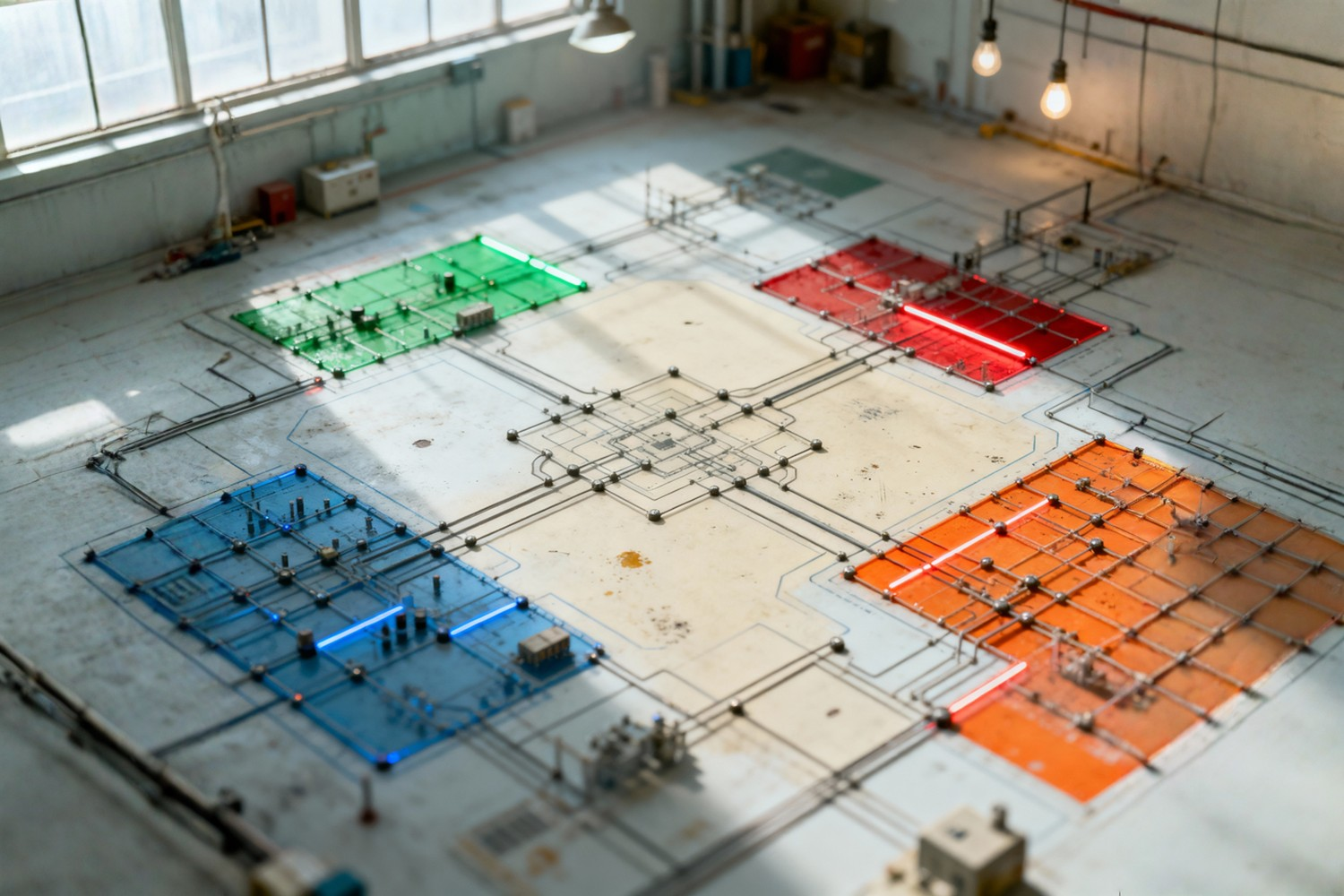
Modernizing legacy systems remains one of the most pressing challenges for organizations today. Many enterprises continue to rely on monolithic architectures that were designed decades ago, often for vastly different technological and business environments. While these systems have provided stability and continuity, they are frequently constrained by tight coupling, limited scalability, and long development cycles. Adapting them to meet modern demands - such as rapid feature delivery, integration with emerging technologies, and responsiveness to changing market conditions - can prove extremely difficult.
Domain segmentation, rooted in the principles of Domain-Driven Design (DDD), offers a structured and practical approach for overcoming these challenges. By decomposing large, monolithic systems into smaller, more manageable domains, organizations gain the flexibility, scalability, and resilience required in today’s digital landscape.
“Splitting monoliths into bounded domains unlocks the flexibility and resilience modern enterprises need.”
The Role of Domain Segmentation in Modernization
At its core, domain segmentation involves dividing a system into discrete, self-contained units of business logic and data. Each of these bounded contexts can then be implemented as an independent microservice. This decomposition creates clear boundaries, prevents unnecessary dependencies, and allows each domain to evolve at its own pace.
The benefits of this approach are significant:
-
Improved maintainability: Each domain is easier to understand, test, and update without risking system-wide disruptions.
-
Scalability: Domains can be independently scaled according to their workload, optimizing resource usage.
-
Faster delivery: Independent deployment of microservices accelerates feature delivery and enables quicker responses to changing business needs.
-
Resilience: Failures are contained within individual domains, reducing the impact of outages across the system.
Implementing Domain Segmentation
Introducing domain segmentation into an existing monolithic architecture is not a one-time effort but a gradual transformation. The process typically involves:
-
Identifying bounded contexts: Analyzing the system to determine natural boundaries, looking for areas of high cohesion and minimal external dependencies.
-
Defining communication protocols: Establishing clear rules for data exchange between services, ensuring consistent and reliable integration.
-
Prioritizing critical domains: Beginning with the most business-critical or high-impact areas ensures early value delivery.
-
Iterative refinement: Continuously monitoring, testing, and refining domain boundaries to accommodate new requirements and optimize performance.
Key challenges during this process include maintaining data consistency across microservices, managing the complexity of distributed systems, and conducting thorough end-to-end testing. Addressing these challenges requires careful design, robust monitoring, and strong alignment between business and technical teams.
“A Domain Model Definition isn’t a static blueprint - it evolves with your business and architecture.”
A Blueprint for Microservices
The Domain Model Definition (DMD) acts as a guiding framework for implementing microservices in a structured manner. Unlike traditional data models, which often create tangled interconnections, the DMD emphasizes independence, clarity, and adaptability.
The DMD defines domains in platform-neutral formats such as YAML, XML, or JSON, making it agnostic to specific technologies. It is not a static artifact; instead, it evolves alongside the system, adapting to new business requirements and organizational changes.
A complete DMD typically includes:
-
A conceptual model of the business domain, including key entities and their relationships.
-
Explicit boundaries that isolate domains and minimize unintended dependencies.
-
Data storage and access definitions for each domain.
-
Service specifications, including APIs, interfaces, and communication protocols.
This structured approach ensures that microservices remain well-defined, maintainable, and aligned with business requirements.
Practical Example of Domain Segmentation
Consider an e-commerce system. Using DMD principles, it might be divided into domains such as:
-
Product Catalog: Managing product data, pricing, and stock levels.
-
Order Management: Handling order processing, fulfillment, and delivery.
-
Customer Relationship Management (CRM): Overseeing customer profiles, preferences, and interactions.
Each domain operates independently, with its own services and data models. This division allows separate teams to manage, deploy, and scale their respective domains without interfering with one another.
Modernization Strategy: Gradual Adoption of Microservices
A phased approach to modernization helps mitigate risks and ensure business continuity. One common strategy involves building microservices that initially share the existing monolithic database. This reduces immediate disruption while paving the way for full decoupling.
Frameworks such as Spring Boot enable the development and integration of microservices with legacy databases. During this phase, strict enforcement of domain boundaries is essential: microservices must only interact through well-defined APIs, never directly accessing another service’s data.
Over time, organizations can transition toward domain-specific databases or partitioned schemas, further enhancing scalability and performance. This gradual process balances risk reduction with the long-term benefits of microservices architecture.
Our approach for enabling Domain Segmentation on IBM i
Sitemule Architect plays a pivotal role in implementing domain segmentation for IBM i systems. It provides tools for importing existing Db2 databases, restructuring them into relational SQL models, and aligning these models with business domains.
The tool applies Domain Model Design principles to define clear boundaries and translate business logic into modular, service-oriented components. Each component serves as the foundation for an independent web application, encapsulating the logic specific to its domain.
“Modernizing doesn’t mean discarding the past - it means redesigning around what matters.”
With its visualization features and dynamic grid interface, Sitemule Architect enables teams to configure domain-specific applications efficiently, without disrupting core ERP operations. APIs generated by Architect ensure consistent communication between services while enforcing domain rules. As business requirements evolve, domains and services can be refined continuously.
The result is a modular, resilient system where each domain can be independently maintained, tested, and enhanced. This transformation supports faster feature delivery, improved system reliability, and reduced operational complexity.
Conclusion
Domain segmentation offers a structured and sustainable approach to modernizing legacy systems. By decomposing monolithic architectures into bounded domains, organizations achieve greater agility, resilience, and scalability while reducing development and maintenance costs.
The Domain Model Definition reinforces this approach by providing a clear and adaptable blueprint for defining and managing domains. Combined with tools such as Sitemule Architect, organizations can transform traditional IBM i systems into modern, service-oriented architectures that support long-term business goals.
In today’s rapidly evolving digital environment, this structured path to modernization ensures that businesses remain competitive, responsive, and well-prepared for future challenges.
This article from our Chief Innovation Officer and IBM Champion Niels Liisbrg is part of IBM’s Redbook “Modernization Techniques for IBM Power”. The Redbook covers many aspects of modernization on the IBM i platform. Download the Redbook