About Sitemule Architect
Build Modern Applications from Legacy Data
Sitemule Architect transforms rigid, legacy-based environments into flexible, domain-driven, service-oriented architectures. It empowers organizations to innovate more quickly and respond more dynamically to changing business demands by redefining how IBM i applications are designed, structured, and extended.
Domain-Driven Application Development
The platform analyzes existing Db2 databases to generate domain models serving as the foundation for modern, data-driven applications and microservices. Applications can be designed, customized, and deployed intuitively without manual coding, establishing a robust, future-proof application framework. The Domain Model Definition is published as a fully functional web application with role-based access control.
Model Studio Visualization
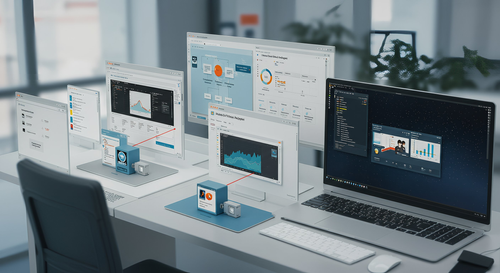
Model Studio visualizes data modeling, application design, and deployment processes, with seamless importing of legacy Db2 structures that can be enriched with metadata for relations, constraints, validations, and presentation logic. Sitemule Architect integrates tightly with Sitemule Blueprint, leveraging detailed architectural information to enable domain segregation and the logical division of existing databases into smaller, more manageable domains
As an extension to the existing Db2 files, organizations can even add new fields, validations, and data extensions without downtime or risk. The result is a unified, consistent data layer supporting both structured and unstructured data through secure JSON-based extensions managed directly within Db2.
The Model Studio provides a complete visual overview of all connected tables, relationships, and entities. Each entity represents a table that can be enriched with metadata, and by adjusting visibility, sorting, and permissions, organizations can tailor how data is displayed and managed. Integration with external tools such as Google Maps, Microsoft Office, and PDFs further extends functionality by bridging internal systems with familiar external platforms.
Advanced Grid and Interface Capabilities
Sitemule Architect provides a complete data overview with search, filtering, grouping, and sorting across all columns. Users can export data in various formats for use on local PCs. The platform integrates options and screens from 5250 programs through Sitemule Workspace, using a scripting method to simulate the user journey to specific options or functions, then popping up emulated 5250 screens. The modernized interface reuses underlying business logic.
Consistent Application Design
Sitemule Architect shares a consistent interface and operation with Sitemule Platform, applications modernized in Sitemule Workspace or deployed via Sitemule Enterprise. Intuitive components include grids, forms, and tree structures. Workflow logic can be visually defined and tailored to meet specific business needs, resulting in cohesive, interactive user experiences.
No-Code Development Environment
The platform bridges the gap between business and IT, enabling domain experts to participate directly in application design and process improvement without programming knowledge. This accelerates development cycles, reduces reliance on specialized resources, and strengthens collaboration across departments.
Business Intelligence Integration
Sitemule Architect makes complex data easy to understand and act upon. Users can model, filter, sort, and group data, then visualize it through dynamic charts and reports. This supports data-driven decisions and provides real-time insights.
Organizations achieve rapid application development with complete control over IBM i data. Legacy programs are incorporated as fully integrated components. Substantial, decades-old libraries are managed into functional domains without changing underlying files, providing effective domain organization. Subfile constraints are replaced with modern grid views, offering enhanced functionality. The seamless addition of metadata and structures creates an enriched data layer. Non-technical experts can participate in development, thereby empowering businesses. Legacy data is transformed into actionable insights for better decision-making.
Implementation Timeline
Successful modernization transforms inflexible legacy systems into adaptable, service-oriented architectures, speeding up development, enhancing maintainability, and aligning technology with business goals, all accomplished within months without disrupting existing systems.