Unlocking the Future Without Losing the Past
For decades, IBM i has powered some of the world’s most critical business systems. Its unmatched stability, security, and backward compatibility have made it the backbone of operations in industries ranging from manufacturing to finance. Yet today, many organisations find themselves constrained by the very strengths that once set IBM i apart.
Workflows have evolved, integration demands have grown, and user expectations have shifted toward modern, intuitive interfaces. Traditional IBM i applications - once perfectly aligned with business needs - are now struggling to keep pace.
“The goal isn’t to replace IBM i - it’s to reshape it for a connected, digital-first world.”
Modernization is no longer optional. However, this does not mean replacing everything that exists. Instead, the goal is to transform IBM i systems in a way that preserves decades of business logic, protects operational continuity, and introduces the flexibility required to thrive in a connected, digital-first world.
This is where structured IT transformation comes in.
The Starting Point: How Traditional IBM i Systems are Built
Traditional IBM i systems are built on an architecture designed for stability and security rather than rapid change. A typical IBM i solution consists of a DB2 database defined by physical and logical files, batch programs for background processing, interactive programs for user-facing tasks, and CL programs - command-based scripts that orchestrate processes and program calls.
These programs are commonly written in RPG or COBOL and compiled into machine-executable objects. The IBM i operating system secures these objects against unauthorised access, ensuring data integrity and consistent operations. For decades, this model delivered exactly what organisations needed: monolithic program objects that encapsulated all business logic, data processing, and presentation for specific work functions.
However, in today’s dynamic business environment, these strengths have become limitations. Each monolithic program typically serves a single, fixed purpose. Even small workflow changes often require altering, recompiling, and retesting entire programs. When multiple applications share similar business rules, developers frequently duplicate code, scattering logic across the system and making synchronised updates labor-intensive and error-prone.
Compounding the challenge, field definitions and validations are typically tied to external file descriptions and display files. Because these validations are rudimentary, much of the checking and formatting ends up embedded in the programs themselves. In many interactive applications, as much as two-thirds of the codebase is dedicated to presentation and validation rather than actual business logic.

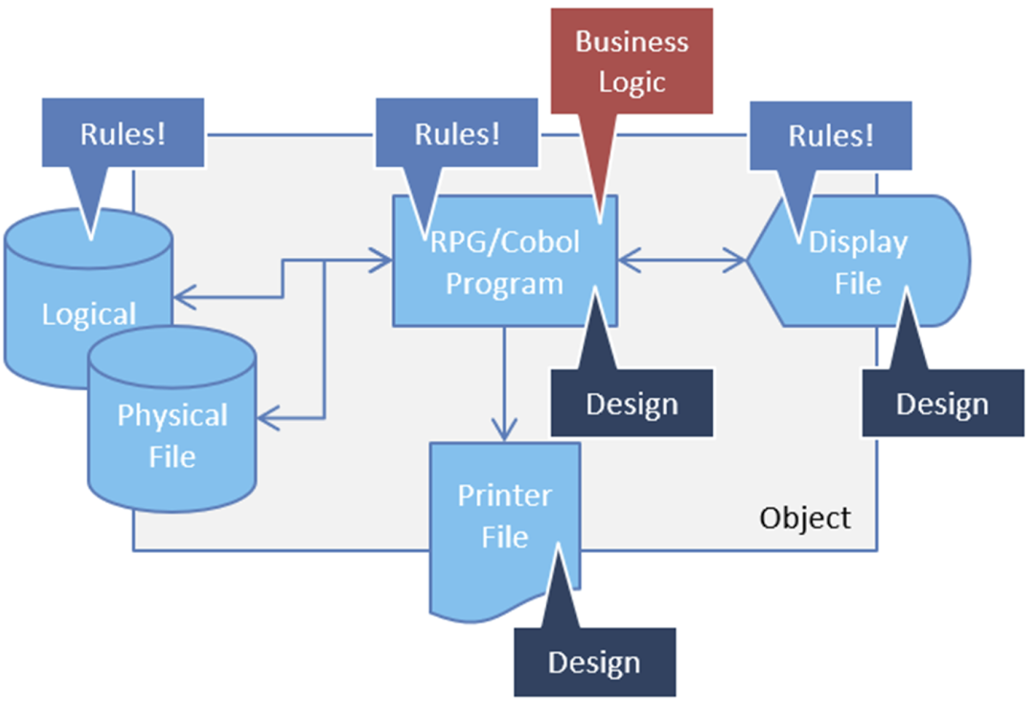
Business rules are therefore fragmented, scattered across database definitions, display files, and multiple program objects. This makes the system harder to maintain and less adaptable to changing business needs.
The IBM i operating system enforces strict object binding: if the structure of a file changes, even slightly, every dependent program must be recompiled. While this has historically been a valued safeguard, it significantly slows down adaptation and complicates the assessment of change impacts.
Over time, many organisations choose to avoid modifying their IBM i applications altogether to escape this complexity. The result is systems that no longer reflect modern workflows, reducing efficiency and limiting innovation.
Yet this situation is far from irreversible. By introducing modern architectural principles while preserving the value of existing investments, IBM i environments can be transformed into agile, integrated platforms capable of supporting the demands of today - and tomorrow.
The Goal: Building a Modern, Flexible, and Future-Proof IBM i System
The purpose of modernization is to evolve, not replace. A modern IBM i system mirrors the layered, modular architectures used by contemporary platforms, while reusing decades of valuable business logic. It introduces flexibility, scalability, and integration capabilities without sacrificing the strengths that make IBM i unique.
"Modern architectures don’t replace business logic - they amplify it.”
A modernized IBM i environment revolves around five core elements that work seamlessly together: an SQL-based database, a centralised domain model, background processing for resource-intensive tasks, a REST-based service layer, and a fully decoupled presentation layer.
At the database level, IBM i already provides a complete SQL interface. Without redefining existing physical and logical files, developers can treat them as SQL tables and indexes, immediately benefiting from advanced query capabilities and performance optimisations. Over time, teams can gradually adopt SQL best practices to improve maintainability and efficiency while maintaining complete backward compatibility.
Introducing a domain model solves one of the biggest challenges of traditional architectures: redundant and fragmented business rules. Validation, formatting, and relationships are centralised into a single model, ensuring consistency across programs, services, and interfaces. This reduces duplication, improves maintainability, and accelerates the implementation of changes.
Batch programs, which handle transaction-heavy or computationally intensive processes, remain relevant in a modernized architecture. These jobs can initially remain unchanged, preserving stability, but over time, they can be refactored into background services with enhanced observability and integration capabilities.
Interactive programs are transformed most visibly. Traditionally, these bundle UI, validation, and business logic into a single structure. In a modernized architecture, these elements are decoupled. Business logic becomes accessible through REST-based services, enabling consumption from any platform. Simpler programs - which typically account for around 80% of interactive applications - can be modernized rapidly. At the same time, more complex workflows, such as order registration or customer onboarding, are decomposed into smaller, composable services.
Finally, the presentation layer becomes completely independent. Modern web technologies, such as JavaScript, utilize REST services to deliver responsive, device-agnostic interfaces. Whether for administrative dashboards or mobile-first customer experiences, UIs evolve rapidly without disrupting business logic or back-end processes.
The result is a layered, modular system that preserves core investments while unlocking integration, flexibility, and innovation.
The Purpose: Enabling Business Agility
The deeper purpose of IBM i modernization is to make organisations more agile, adaptable, and competitive. By decoupling business logic, services, and interfaces, systems gain the flexibility to evolve in step with business needs.
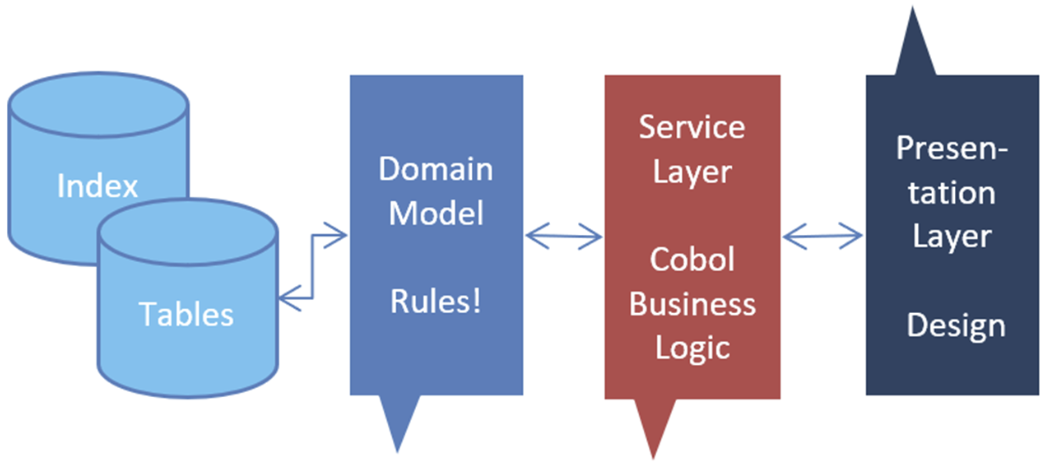
Changes can now be introduced incrementally and safely. For example, new columns can be added to database tables without recompiling dependent programs, and new workflows can be supported simply by recombining existing services. Old and new systems can run in parallel, allowing companies to adopt modern capabilities without disrupting daily operations.
“You don’t need to rewrite everything to move forward - you need to restructure what you already trust.”
This approach also invests in people, not just technology. Existing IBM i developers are upskilled through structured training programs, learning modern languages and tools like Java, Node.js, JavaScript, and REST-based architectures. This builds confidence, retains valuable institutional knowledge, and attracts younger developers to the platform, creating a blended workforce combining experience and innovation.
By embracing service-oriented architectures and modern development practices, organisations unlock greater speed, scalability, and integration potential - all while continuing to leverage their unique competitive advantages.
What Is IT Transformation?
IT transformation is the strategic execution of this modernization journey. It re-architects systems step by step, ensuring continuity of business operations while introducing modern capabilities.
Unlike full-scale migrations, which often involve expensive rewrites and operational disruptions, IBM i transformation is an incremental and non-disruptive process. Old and new components coexist throughout the process, minimising risk and avoiding downtime.
“Transformation isn’t disruption. It’s continuity, delivered through modern tools and modular thinking.”
At the same time, the transformation modernizes the IT organisation itself. Development teams gain exposure to modern tools, frameworks, and languages while continuing to build on their existing expertise. Over time, this approach creates hybrid teams capable of managing both legacy systems and modern architectures, reducing dependency on external consultants and future-proofing the workforce.
This incremental evolution creates a modular, service-driven foundation. Workflows that once required significant redevelopment can now be supported by recombining services in new ways. Individual services can even be rewritten in different programming languages without impacting the wider architecture. Unit testing, automated deployments, and microservices principles further enhance system reliability and speed of delivery.
IT transformation ensures that companies are no longer locked into rigid architectures or outdated workflows. It enables integration with modern ecosystems - mobile applications, cloud platforms, and external partners - while keeping critical business processes intact.
What We Deliver
Successfully executing this transformation requires the right tools, frameworks, and methodologies. We provide a complete enablement suite called Sitemule, designed to guide organisations through every stage of modernization while minimising risk.
At the foundation is a web and application server environment that delivers REST-based services and modern web applications. A domain model framework, supported by a graphical designer, centralises data definitions, relationships, and validation rules, ensuring consistency across all system layers.
Our web framework supports content management, product information management, websites, webshops, and portals in general for modern user experiences. An accompanying application framework manages administration, security, menu systems, and user roles. Together, these frameworks enable businesses to deliver responsive, device-independent interfaces while leveraging existing business logic.
Our service development tools accelerate the creation of RESTful services, automatically generating endpoints based on existing data and processes. RPG, COBOL, and CL applications are integrated seamlessly using a pre-compiler, enabling developers to reuse existing code while restructuring it into modular, service-oriented components.
Crucially, our methodology ensures that transformation happens in controlled stages, with old and new systems running in parallel. There is no need for costly infrastructure overhauls or disruptive downtime. IBM i’s built-in authorisation, user management, subsystems, and library lists are fully respected throughout the process.
To ensure success, we complement our tools with training and enablement programs. Your teams gain hands-on experience with microservices, REST architectures, MVC/MVVM design patterns, and responsive front-end frameworks, ensuring that both systems and people evolve together.
Preserving Strength, Unlocking Agility
IBM i modernization is not about replacing the past - it is about building on it. The systems running today hold decades of business intelligence and unique competitive advantages. By combining that strength with modern, modular architectures, organisations create platforms that are more flexible, more integrated, and better prepared for the future.
Through structured transformation, companies can evolve without disruption, integrate without compromise, and innovate without limits. The result is not just a modernized system, but a more agile organisation - one where technology no longer constrains business strategy but enables it.
IBM i has always been a platform built for longevity. With the right approach, it can now also be a platform built for continuous reinvention.
Frequently Asked Questions & Takeaways
- Why are traditional IBM i applications now seen as a limitation?
- Because their monolithic design makes even small workflow changes slow and costly. Business logic, data, and presentation are tightly bound, which limits flexibility and integration. What once guaranteed stability now restricts agility and innovation.
- What does it mean to modernize IBM i “without replacing it”?
- It means re-architecting existing systems so they act like modern, modular platforms while keeping proven business logic intact. Rather than rewriting everything, organisations restructure and expose existing code as services, ensuring continuity and lowering risk.
- How does a modern IBM i architecture differ from the old model?
- A modern system separates layers into SQL-based data, a central domain model, REST services, and independent web interfaces. This modular approach allows quick updates, better integrations, and consistent business rules across all applications.
- What role does IT transformation play in this process?
- IT transformation is the step-by-step execution of modernization. Old and new components run in parallel, allowing gradual evolution without downtime. It also upskills existing developers and introduces modern tools, building a workforce ready for both legacy and future systems.
- How does Sitemule support organisations on this journey?
- Sitemule provides a complete enablement suite with frameworks, service-generation tools, and training programs that guide teams through each modernization phase. This structured, low-risk approach lets companies evolve their IBM i environments into agile, integrated, future-ready platforms.