
Exploring the Runtime Engines of the Sitemule Platform
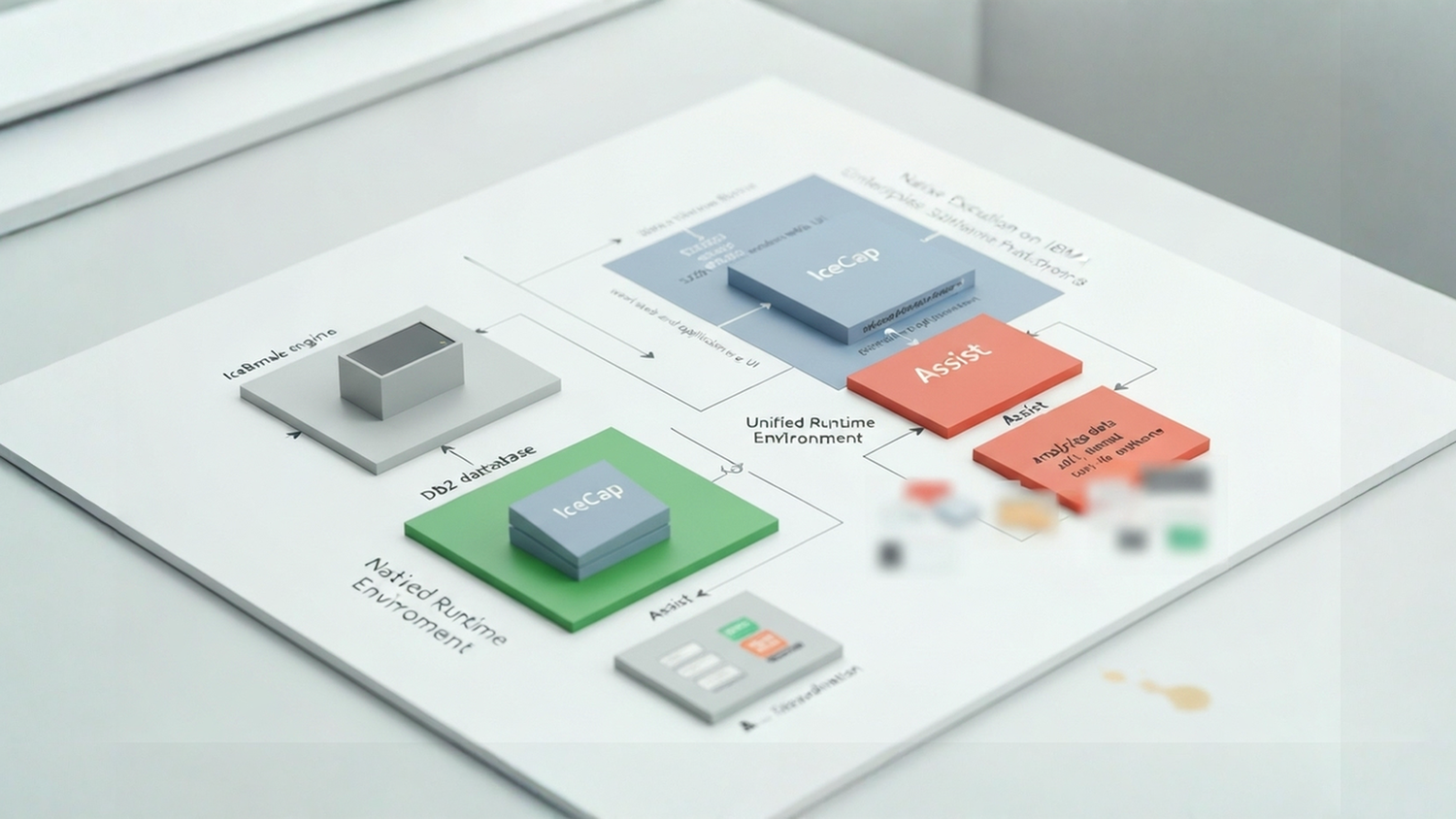
The Sitemule Platform is built on a unified runtime architecture designed specifically for IBM i environments. At the center of this architecture are four tightly integrated engines - IceBreak, IceCap, BlueSeries, and BlueNote. Each engine fulfills a distinct role, yet all operate within the same native environment, forming a cohesive execution layer that supports modernization, communication, and operational resilience.
Rather than relying on fragmented middleware or external services, the Sitemule approach embeds all critical capabilities directly into IBM i. This design ensures consistency, performance, and governance across the entire platform.
"Rather than relying on fragmented middleware or external services, the Sitemule approach embeds all critical capabilities directly into IBM i. This design ensures consistency, performance, and governance across the entire platform."
IceBreak Engine: The Core Execution Foundation
The IceBreak Engine is the foundational runtime and application engine of the Sitemule Platform. It operates entirely within IBM i, providing a native web and application server without requiring external technologies such as Apache or WebSphere. This eliminates unnecessary architectural layers and allows the system to fully leverage IBM i’s inherent performance and reliability.
IceBreak enables organizations to modernize their systems while preserving existing business logic. Traditional RPG, COBOL, and SQL programs can be executed as modern web applications, APIs, and microservices without rewriting code. This capability is critical for enterprises that depend on stable legacy systems but need to extend them into modern digital environments.
From a technical perspective, IceBreak combines execution, scalability, and security into a single runtime. It supports intelligent load balancing, multi-threaded processing, and session management, allowing applications to scale dynamically under heavy workloads. Direct integration with Db2 ensures high-performance data access without middleware overhead, while built-in support for JSON and XML enables seamless interaction with modern web services.
In essence, IceBreak acts as the execution backbone of the Sitemule Platform. All other engines rely on it to run applications and process business logic.
IceCap Engine: The Modern User Experience Layer
The IceCap Engine introduces a modernization layer focused on user interaction. While IceBreak handles execution, IceCap transforms how users engage with IBM i applications by converting traditional 5250 green screens into modern, browser-based interfaces.
This transformation occurs without altering the underlying applications. IceCap intercepts the 5250 datastream, converts it into structured data, and renders it as a responsive web interface. Because the original business logic remains untouched, organizations avoid the risks typically associated with large-scale system rewrites.
"IceCap transforms traditional 5250 green screens into modern, browser-based interfaces without altering the underlying applications. Because the original business logic remains untouched, organizations avoid the risks typically associated with large-scale system rewrites."
The impact of this approach is significant. Legacy applications become accessible through modern interfaces that support intuitive navigation, structured workflows, and interactive elements such as dropdowns and validation rules. Processes that previously required multiple screens can be consolidated into streamlined workflows, improving efficiency and reducing user error.
IceCap also enables integration with other enterprise systems. Existing IBM i applications can interact with CRM platforms, ERP systems, or external services without requiring code-level changes. This capability allows organizations to extend the value of their existing systems while aligning with modern business processes.
Within the platform architecture, IceCap operates above the execution layer. It enhances usability and accessibility while relying on IceBreak to handle processing and data management. This separation of concerns allows organizations to modernize user experiences independently of backend systems.
BlueSeries Engine: The Native Communication Layer
The BlueSeries Engine provides integrated communication capabilities directly within IBM i. It embeds email, SMS, and FTP services into the same runtime environment as business applications, removing the need for external communication servers or middleware.
In traditional architectures, communication often depends on separate systems, introducing latency and complexity. BlueSeries eliminates this fragmentation by ensuring that all communication processes occur within IBM i. Messages and file transfers are triggered directly by business events, processed internally, and logged for full traceability.
This design significantly improves performance. Because there are no external routing steps, communication occurs in real time with minimal delay. At the same time, it strengthens governance, as all actions inherit IBM i’s native security model, including user authorities and auditing mechanisms.
BlueSeries also simplifies system management. Communication endpoints and workflows are configured centrally, reducing the need for custom scripts or external tools. The result is a streamlined infrastructure where communication is tightly integrated with business logic.
Within the Sitemule architecture, BlueSeries acts as the communication backbone. It works closely with IceBreak, which triggers communication events, and BlueNote, which relies on it to deliver alerts and notifications.
BlueNote Engine: Monitoring and Operational Resilience
The BlueNote Engine introduces real-time monitoring and automated response capabilities directly within IBM i. It continuously observes system activity, including jobs, message queues, and subsystems, detecting issues as they occur.
Unlike traditional monitoring approaches that depend on external tools, BlueNote operates within the same environment as the applications it monitors. This allows it to detect events instantly and respond without delay. When a problem is identified, the engine can execute predefined actions such as restarting jobs or triggering corrective processes.
A key strength of BlueNote is its rule-based architecture. Conditions and responses are defined within the platform, allowing administrators to configure monitoring behavior without coding. Events are logged in Db2, ensuring full traceability and supporting audit requirements.
BlueNote also integrates seamlessly with the communication layer. When critical events occur, it uses BlueSeries to send immediate notifications via email or SMS. This ensures that system administrators are informed in real time and can take action when necessary.
In the overall architecture, BlueNote serves as the operational intelligence layer. It oversees the health of all platform components, ensuring continuous operation and minimizing downtime.
Interaction Between the Engines
The four engines are designed to function as a unified system rather than independent components. Their interaction creates a continuous operational cycle that connects execution, user interaction, communication, and monitoring.
A typical workflow illustrates this integration clearly. An application executed by IceBreak processes business logic and data. The user interacts with this application through a modern interface generated by IceCap. When a business event occurs, such as the completion of a transaction, BlueSeries is triggered to send notifications or transfer data. At the same time, BlueNote monitors the entire process, ensuring that any issues are detected and resolved immediately.
This interaction forms a closed-loop architecture. Each engine contributes a specific capability, yet all operate within the same runtime environment, ensuring consistency and eliminating delays caused by cross-system communication.
"By embedding execution, modernization, communication, and monitoring into a single platform, Sitemule eliminates the need for fragmented architectures. This unified approach delivers improved performance, strengthened security, and reduced complexity."
Why These Engines Are Essential
The importance of these engines lies in their ability to unify all critical aspects of enterprise computing within IBM i. By embedding execution, modernization, communication, and monitoring into a single platform, Sitemule eliminates the need for fragmented architectures.
This unified approach delivers several key advantages. Performance is improved because all processes run natively within IBM i, avoiding external dependencies. Security and governance are strengthened, as all operations inherit the platform’s built-in controls. Complexity is reduced, making systems easier to manage and maintain.
Equally important is the platform’s flexibility. Each engine addresses a specific layer of functionality, allowing organizations to adopt capabilities incrementally while maintaining full integration. This modular yet unified design supports both stability and innovation.
Conclusion
The IceBreak, IceCap, BlueSeries, and BlueNote engines collectively define the Sitemule Platform’s architecture. Rather than functioning as isolated components, they form a cohesive runtime ecosystem where execution, modernization, communication, and monitoring are unified within IBM i.
-
IceBreak provides the execution foundation
-
IceCap modernizes user interaction
-
BlueSeries enables real-time communication
-
BlueNote ensures operational resilience
Together, they transform IBM i into a fully integrated, modern enterprise platform, capable of supporting legacy applications while meeting the demands of contemporary digital environments. This unified architecture is what makes the Sitemule Platform both powerful and future-ready.
FAQ & Takeaways
What are the four runtime engines in the Sitemule Platform?
How does the IceBreak Engine modernize IBM i applications?
Can IceCap modernize 5250 green screens without changing business logic?
Why does Sitemule embed all engines natively in IBM i instead of using external services?
How do the Sitemule engines work together for operational resilience?
Modules

The Companies We Help
We provide solutions and services that support both standard and tailor-made systems for companies worldwide, serving a wide range of industries such as banking, finance, insurance, manufacturing, retail, logistics, and beyond. Let us help you - get in touch today!